... the birth of the world and beings greater than all others ...
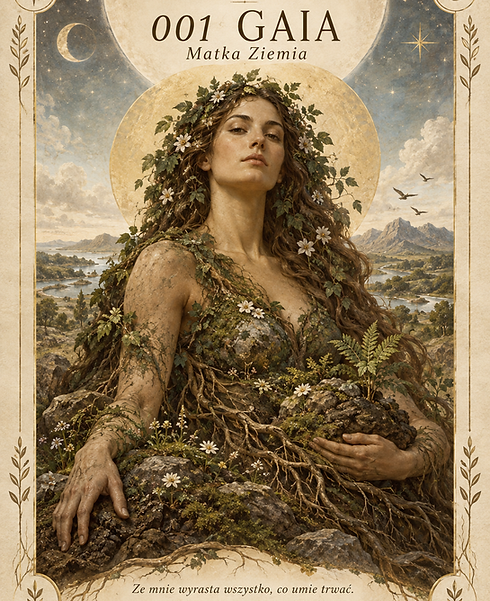
GAIA
* PRELUDE OF THE GATHERER
A hand placed on the ground
On the first night, I didn't open a single book.
I went outside and knelt down.
The earth was cool. After a whole day it had kept a little sun beneath its surface, but for my hand it now held only night:
damp, dark, smelling of roots.
"Where should I begin?" I asked.
continue...
...
* PRELUDE OF THE GATHERER
A hand placed on the ground
On the first night, I didn't open a single book.
I went outside and knelt down.
The earth was cool. After a whole day it had kept a little sun beneath its surface, but for my hand it now held only night:
damp, dark, smelling of roots.
"Where should I begin?" I asked.
She didn't answer.
I ran my fingers over a lump of clay. It crumbled without resistance.
"From the beginning?"
Silence.
Only after a moment did I notice an ant passing between my little finger and a blade of grass.
Then a second one.
Somewhere deep down, a root stirred.
The earth didn't speak in words.
She spoke in the weight of a stone that doesn't need a name to exist.
She spoke in the scent of wet grass.
She spoke in the fact that everything living touches it, if only for a moment.
So I understood that the first story shouldn't begin with a heroine.
Nor with a goddess.
Not even with a name.
One must begin with the place that came before.
I laid both hands on the ground.
And only then did the first tale open.
THE TALE
PART 1
Before There Was a Shore
In the beginning there was no beginning of the kind people later invented.
There was no sunrise, because there was not yet a place from which one could look at the sun.
There was no sunset.
There was no mountain, no valley.
There was not even high and low.
There was a rift.
An opening.
Chaos.
Not disorder — not scattered things, because things did not yet exist.
Rather, a space that nothing filled.
A clearing before the world.
And then Gaia appeared.
She came from no road.
She had no mother from whose body she emerged, no home one could knock on and say:
here is where her life began.
She simply was.
Vast.
Wide.
Certain beneath the feet of beings who had yet to learn to walk.
She did not look like a woman lying upon the darkness.
She did not yet have a face, eyes, hair.
It would be later humans who needed faces for their gods.
At the beginning her face was every place that could ever come to be.
Her back — a plain no one had yet named.
Her hollows — valleys still to come.
Her weight — the promise of stones.
She was earth not because she possessed earth.
She was earth entirely.
There was no one then who could say:
this field is mine.
There were no borders.
No walls.
No temples.
Gaia did not fit inside the world.
Gaia was that on which the world could happen.
In that same oldest song, deep Tartarus also appeared, far beneath everything,
and Eros — the force drawing together what was separate.
Night and darkness received their places.
The world began to differentiate itself like the body of a child who, even before its first breath, already knows where the heart will be, where the hand, where the closed eyelids.
But Gaia remained wide.
She was in no hurry.
She had nowhere, after all, to go.
Every road anyone would ever walk would run across her.
Every house would stand on her.
Every body would one day be given back to her.
She did not know this yet.
Or perhaps she alone had known it from the start.
That to be the earth means to let things come.
And go.
That not everything that grows from your body remains yours.
That the motherhood of the world would not be a holding on.
It would be a place.
So Gaia stretched out beneath the first darkness.
And waited.
Not for someone.
For a possibility.
PART 2
The One Who Was to Cover Her
Uranus grew from her first.
She needed no husband for this.
None yet existed.
She brought forth the Sky, starred and vast, meant to equal her in size.
So the old song said:
equal to herself.
One can try to imagine that moment.
But everything we might use to do so will come from a world that arose later.
Blue.
Clouds.
Distance.
Light.
Back then these did not yet carry their ordinary meanings.
There was only Gaia.
And above her, something that had not existed before.
Uranus stretched out over her from edge to edge.
Only then was above truly born.
And with it — below.
The first distance.
The first space between.
Gaia also brought forth the Mountains.
High ridges lifting her body toward what lay above her.
Rock rose toward the sky.
Cracks filled with shadow.
Places came into being where nymphs would one day live, where snow would linger longer than on the plains, where humans would learn to speak more quietly, because height itself would teach them smallness.
Then Gaia brought forth Pontus.
The Sea.
Without a husband.
Without help.
Deep water stirring at her shores.
And when the sea first touched the earth, there had to be a first shore.
A place where one ended and the other began.
Though not entirely.
Water crept into sand.
Sand vanished beneath water.
The boundary moved with the wave.
Perhaps Gaia had already learned something people would take a very long time to learn:
that true boundaries are not always walls.
Sometimes they are a line that lets two things meet without having to become one.
Sky above her.
Sea beside her.
Mountains rising out of her.
The world was no longer uniform.
And yet everything still belonged to one great body.
If anyone could have walked through that young cosmos then, they would have found no place where Gaia was far away.
The stone was her.
The shore was her.
The valley.
The dust.
The dark earth waiting for seeds that did not yet exist.
She had not made the world the way a craftswoman stands beside her finished work.
She had not built it with her hands.
She had brought it forth from herself.
And so she could never stand outside it and say:
here is the thing I made.
Every glance at the world was, at the same time, a glance at her.